What Is Concierge
Audiology?
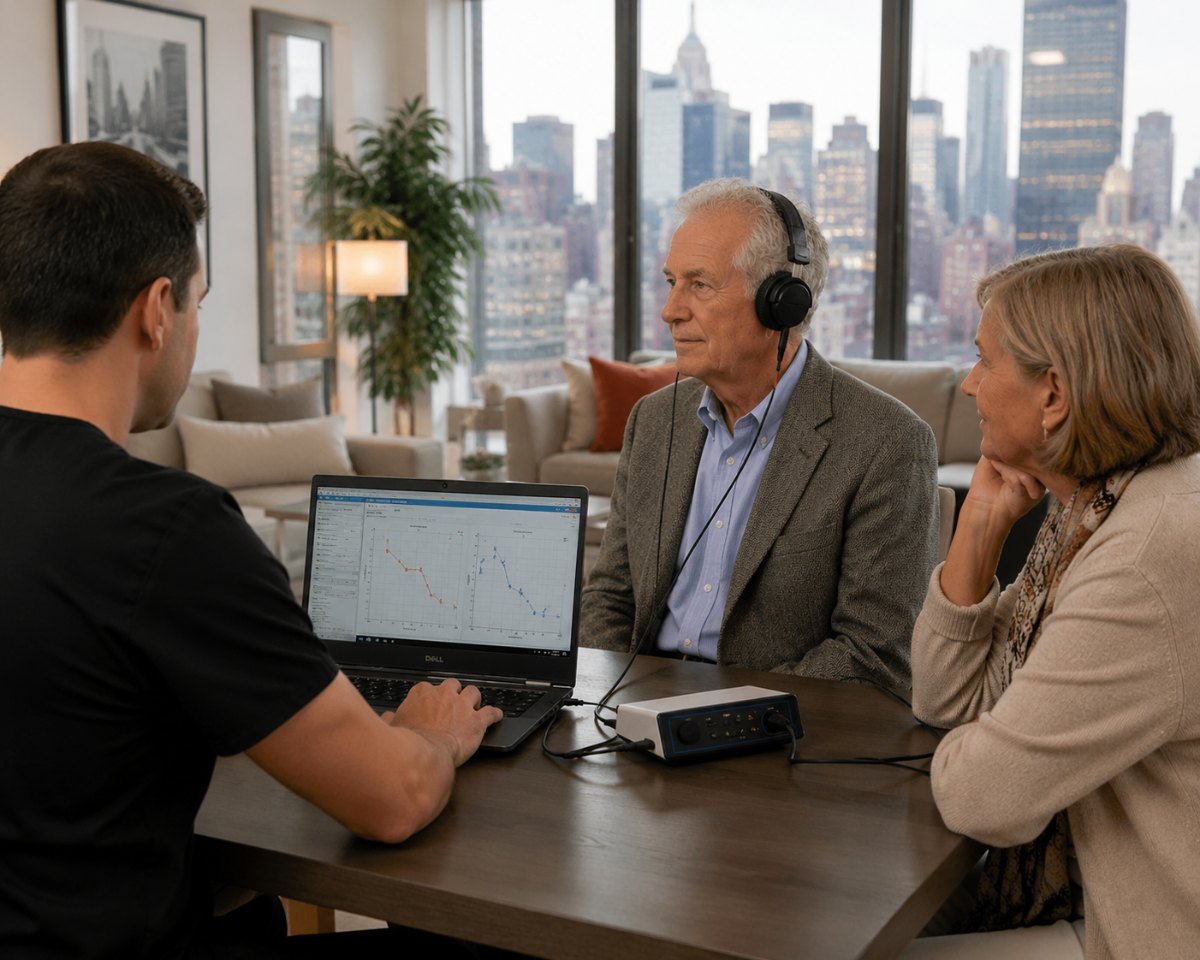
Doctor-level hearing care that comes to you: testing, hearing aid fittings, and follow-up delivered at home in Manhattan, Brooklyn, Queens, and Nassau County. A concierge visit fee applies to every appointment.
Most hearing care asks the patient to do the traveling: get to the office, sit in the waiting room, fit your hearing into the clinic's day. Concierge audiology reverses that. A Doctor of Audiology brings the essential parts of the clinic, calibrated testing equipment, fitting and programming tools, and unhurried time, to your home, and builds your care around your life instead of the other way around.
What "concierge audiology" actually means
Concierge audiology is a model of care, not a different kind of medicine. The clinical work is the same work we do in our Midtown Manhattan and Garden City offices: diagnostic hearing testing, hearing aid fittings, programming, cleanings, repairs, and counseling. What changes is the setting and the pacing. Visits happen where you are comfortable, appointments are longer, and Pinnacle’s doctoral team coordinates your care over time. At Pinnacle, concierge care is led by our doctoral team, including Dr. Eric Nelson, a former Audiology Supervisor at Weill Cornell Medicine.
Who in-home hearing care helps
Hearing loss is common, and it becomes more common with age: roughly one in three adults between 65 and 74 has hearing loss, and nearly half of adults over 75 do. Yet many of the people who would benefit most from care face the biggest barriers to getting it. In-home audiology is often the right fit for:
- Older adults and their families, especially when mobility, transportation, or fatigue makes an office trip a project rather than an errand.
- People with busy, inflexible schedules who would otherwise postpone hearing care for months.
- Residents of assisted living and memory care communities, where familiar surroundings make testing and fitting far more successful.
- Anyone recovering from illness or surgery who needs hearing aid support before they can travel again.
How an in-home visit works
A first visit usually begins the way a good office visit does: a conversation about your history, your concerns, and the listening situations that matter most to you. Your audiologist then performs hearing testing with calibrated portable equipment, examines your ears, and reviews the results with you in plain language, the same day, at your kitchen table rather than across a desk.
If hearing aids are recommended, fittings and follow-ups also happen at home. That includes programming, verification, Bluetooth and app setup, and training for you and, when helpful, your family members. Because the audiologist hears your actual living room, television, and telephone, the fine-tuning often reflects your real listening life more closely than a clinic simulation can. Our at-home audiology page describes the full service in detail.
Where at-home care fits
Across Manhattan, Brooklyn, Queens, and Nassau County, the pattern is consistent: the hardest part of hearing care is not the appointment, it is everything around the appointment. An Upper West Side patient who no longer drives, a Garden City family coordinating care for a parent, a Midtown executive who cannot give up half a day, or an assisted living community in Nassau County with residents overdue for testing can all face the same barrier.
Concierge visits bring care to them, and a concierge visit fee applies to every appointment. For patients who can travel, our Midtown Manhattan office, about a block from Penn Station, and our Garden City office remain the home base for care.
In-home care vs. remote follow-up
These are two different tools, and we use both. In-home care is a full clinical visit: hands-on testing, physical ear examination, real-ear verification, and repairs. Remote follow-up, by contrast, is a video visit for adjustments and troubleshooting after you are established as a patient; modern hearing aids allow us to fine-tune programming from a distance. Remote care works well for tweaks between visits, and we offer it where clinically appropriate and where licensure allows, currently for patients in New York, New Jersey, and Vermont. It does not replace the periodic hands-on visit; it extends it. Our remote care and transfer page explains the options.
When an office visit is still the better choice
Honest guidance matters here: some situations call for the office. Sound-treated booths allow the most comprehensive diagnostic testing, and certain evaluations, such as detailed tinnitus workups or complex medical cases that may need physician referral, are best done on site. If something we find at home needs office-level equipment, we will tell you plainly and help arrange the visit. Many patients ultimately use a mix: office visits for major milestones, home visits for ongoing care.
Getting started
If an in-home visit sounds right for you or someone you love, start with a conversation. Call 646-436-7590, use our contact page, or read more about concierge audiology in Manhattan, Brooklyn, Queens, and Nassau County; a concierge visit fee applies to every appointment. If you are unsure whether testing is needed at all, a comprehensive hearing evaluation, at home or in office, is the right first step.
References
- National Institute on Deafness and Other Communication Disorders. "Quick Statistics About Hearing." nidcd.nih.gov.
- World Health Organization. (2021). World Report on Hearing. Geneva: WHO.
- Centers for Medicare & Medicaid Services. "Hearing and Balance Exams." Medicare.gov.
Medically reviewed by: Dr. Eric G. Nelson, Au.D., CCC-A, Doctor of Audiology, Founder and Clinical Director of Pinnacle Audiology, and former Audiology Supervisor at Weill Cornell Medicine. Reviewed July 2026. This article is for general education and is not a substitute for an individual hearing evaluation.
Clinical Sources
Get expert
hearing care.
Comprehensive evaluation, honest guidance, and long-term support, from New York's leading independent audiology practice.