Bringing Better Hearing Home:
In-Home Hearing Care for Seniors in NYC
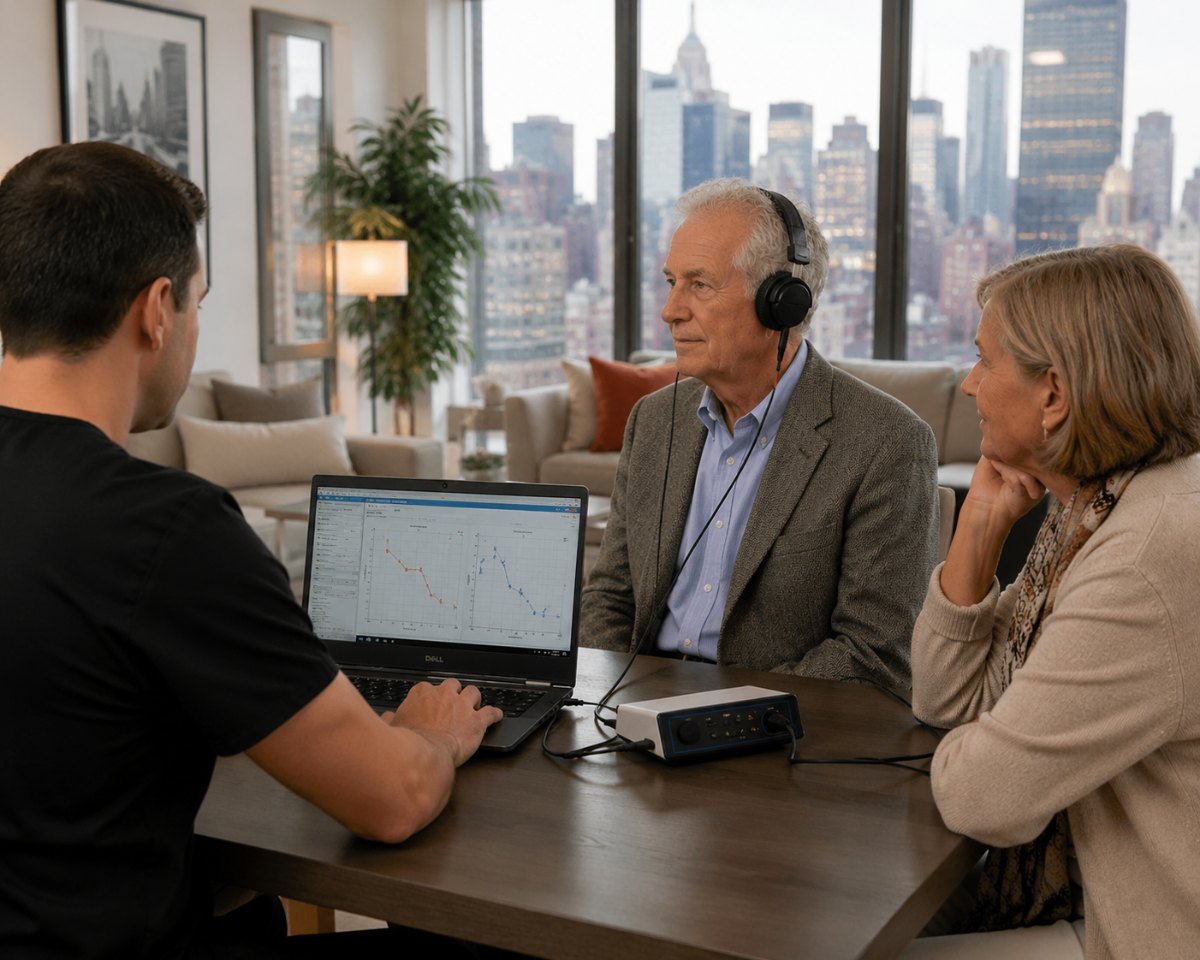
How Pinnacle Audiology serves seniors, assisted living residents, and memory care communities at home in Manhattan, Brooklyn, Queens, and Nassau County; a concierge visit fee applies to every appointment.
Among the populations most profoundly affected by hearing loss, older adults in residential care settings, assisted living communities, memory care units, skilled nursing facilities, face a set of barriers that are rarely addressed by the standard hearing healthcare system.
The Burden of Untreated Hearing Loss in Older Adults
Presbycusis, age-related hearing loss, is the most prevalent sensory impairment among older adults, affecting approximately one in three adults over 65 and nearly two in three adults over 75. The prevalence is even higher in residential care settings, where estimates range from 60 to 80 percent of residents having clinically significant hearing loss.
Despite this prevalence, hearing loss is dramatically undertreated in this population. Studies of nursing home residents have found that fewer than 25 percent of residents with documented hearing loss use hearing aids. Social isolation, a direct consequence of the communication barriers that hearing loss creates, is an independent risk factor for both cognitive decline and depression in older adults.
The Challenges of Standard Audiology Care for This Population
Transportation to an off-site audiology practice requires staff coordination, family involvement, or medical transport. Many residents with cognitive impairment are unable to participate in standard audiometric testing procedures that require sustained attention and reliable behavioral responses.
Hearing aid management presents additional challenges in residential settings. Hearing aids are small, expensive, and easy to lose. They require regular cleaning, filter replacement, and battery management, tasks that many cognitively impaired residents cannot perform independently.

Mobile Audiology: Bringing Comprehensive Care to the Resident
Mobile audiology brings calibrated audiometric testing equipment, real-ear measurement systems, hearing aid fitting and programming technology, and counseling resources directly to the resident's location. Evaluations can be conducted in the resident's room, a quiet activity room, or any suitable space within the facility.
On-site hearing aid fitting and follow-up care within the residential setting fundamentally changes the continuity of care available to these residents. Rather than a single fitting appointment with limited follow-up, the audiologist becomes a regular presence in the facility, available for routine adjustments, device maintenance, troubleshooting, and the staff training that is essential to sustainable hearing aid use in this population.
Memory Care: A Special Clinical Context
Memory care units present specific considerations that distinguish them from standard assisted living. Residents with moderate to severe dementia may not be able to articulate hearing difficulties or consent to evaluation in a conventional sense. The audiologist working in this setting must partner closely with direct care staff and family members to identify residents with apparent communication difficulties, behavioral changes that may reflect hearing loss (increased withdrawal, increased agitation during care routines, failure to respond to their name or to verbal instructions).
The communication gains from successful hearing intervention in memory care residents can be meaningful even when the intervention is simple. Medically healthy ear canals, functional hearing aids, and staff trained in effective communication techniques can produce observable improvements in a resident's ability to engage in care interactions.
Working with Families
Families of residents in long-term care settings play an essential role in hearing healthcare. Family members often first notice the signs of hearing difficulty during visits, a parent who doesn't turn when called, who responds to questions with unrelated answers, who seems less engaged in conversation than in previous visits.
Hearing care should not stop at the door of a residential facility. It is as essential there as anywhere else.
For families across New York City caring for an aging parent, this is the reassuring part: expert hearing care can come to your loved one, in their room, at their pace, on their terms. At Pinnacle Audiology, our concierge and in-home audiology brings the full diagnostic and fitting experience to seniors at home and in residential communities in Manhattan, Brooklyn, Queens, and Nassau County. A concierge visit fee applies to every appointment.
What an in-home visit includes
Concierge care brings the full clinic to the living room. A doctoral audiologist arrives with portable diagnostic equipment and can run a complete hearing evaluation, take ear impressions, fit and program hearing aids, clean and repair devices, and handle follow-up adjustments, all in familiar surroundings. For many older adults, being seen at home means a calmer, unrushed visit and far better follow-through than a trip across the city allows.
Who it helps most
In-home care is ideal for anyone for whom getting to an office is hard: limited mobility, memory concerns, no easy transportation, or simply the fatigue that makes an outing a major event. It is also a relief for family caregivers who would otherwise coordinate transport and waiting rooms. For assisted living and memory care communities, on-site visits keep residents hearing well, which directly supports engagement, safety, and cognitive health.
Care that continues
Hearing care is not one visit, and the at-home model is built for the long relationship: the doctoral team returns for tune-ups, cleanings, and changes over time, so nothing slips through the cracks. We serve homes and communities in Manhattan, Brooklyn, Queens, and Nassau County. A concierge visit fee applies to every appointment. Our concierge at-home care page explains how to arrange a visit.
References
- Lin, F.R., Pike, J.R., Albert, M.S., et al. (2023). "Hearing intervention versus health education control to reduce cognitive decline in older adults with hearing loss (ACHIEVE): a multicentre, randomised controlled trial." The Lancet. 402(10404):786–797.
- Livingston, G., Huntley, J., Liu, K.Y., et al. (2024). "Dementia prevention, intervention, and care: 2024 report of the Lancet standing Commission." The Lancet. 404(10452):572–628.
- Slade, K., Plack, C.J., & Nuttall, H.E. (2020). "The effects of age-related hearing loss on the brain and cognitive function." Trends in Neurosciences. 43(10):810–821.
- World Health Organization. (2021). World Report on Hearing. Geneva: WHO.
Clinical Sources
Get expert
hearing care.
Comprehensive evaluation, honest guidance, and long-term support, from New York's leading independent audiology practice.