Auditory Processing Disorder:
What Current Research Tells Us
A balanced look at the science of auditory processing disorder: how it is defined, why it remains debated, how it is tested, the conditions it overlaps with, and what the evidence says about helping.
Service availability: Pinnacle Audiology now offers adult CAPD testing in NYC for ages 18+ only. The research discussion below includes children for educational context; it does not describe pediatric testing available at Pinnacle.
Almost every week, a parent sits across from an audiologist and says a version of the same thing: my child’s hearing was tested and it is fine, but something about listening is not fine. They miss directions. They fall behind in a noisy classroom. They ask “what?” more than their friends do. Adults describe it too, in meetings, on calls, in restaurants where everyone else seems to cope. When the ears detect sound normally but the experience of listening breaks down, the conversation often turns to auditory processing disorder.
Auditory processing disorder, also written as APD, and often called central auditory processing disorder, or CAPD, is one of the more genuinely interesting and genuinely debated topics in audiology. This article lays out what the current research actually supports, where reasonable experts still disagree, and how a careful clinician turns a vague listening complaint into something useful.
Detection Is Not the Same as Understanding
A standard hearing test answers a specific question: how soft a sound can you detect at each pitch. That is essential information, and it is where responsible care begins. But detecting sound is only the entry point. Once a signal reaches the brainstem and the auditory cortex, it has to be separated from background noise, sequenced in time, matched to stored patterns, and mapped onto meaning, all within milliseconds and all continuously. Central auditory processing refers to that cascade: what the central auditory nervous system does with sound after the ear has done its job.
APD describes difficulty in that cascade. The formal descriptions from the American Speech-Language-Hearing Association and the American Academy of Audiology frame it as a deficit in the neural processing of auditory information that is not primarily explained by higher-order language, cognitive, or related factors, though those factors frequently travel alongside it. In plain terms: the hardware for detecting sound can look intact while the brain still struggles to organize what it receives.
Why APD Remains a Debated Field
It would be dishonest to present APD as a settled diagnosis with a single, universally agreed test. It is not, and families deserve to hear that clearly. Professional bodies define APD in broadly similar ways, yet they differ on how strictly to separate it from attention and language, on which tests to require, and on what cutoff should count as a “fail.” The British Society of Audiology, ASHA, and the American Academy of Audiology each published guidance that agrees on the core concept while diverging on the details.
One consequence is that reported prevalence and diagnostic rates shift depending on the tests chosen and the cutoff rules applied. Use a looser criterion, or a single test in isolation, and more children “have” APD. Use a stricter, multi-test pattern requirement, and fewer do. This is not a reason to dismiss APD. It is a reason to be careful, to use a battery rather than one measure, and to interpret results against a real child with a real history rather than against a number alone.
The Complaints That Bring People In
Functional listening reports are not soft data. They are often the most important part of the evaluation, because they describe the conditions under which listening actually fails. In children, the story tends to center on school: trouble understanding the teacher across a busy room, missing steps in spoken instructions, needing more repetition than classmates, and doing visibly better when information is written or demonstrated. Teachers frequently notice it before anyone else.
Teenagers and college students describe a different flavor of the same problem: difficulty taking notes while listening, losing the thread of fast lectures, and real fatigue after a day of concentrated listening. Adults report struggling to follow one voice among many, exhaustion after noisy meetings, and a growing preference for written follow-up. A careful case history, paired with structured questionnaires and input from family, teachers, or partners, turns these anecdotes into a testable picture. It also flags the many non-auditory explanations that must be weighed before anyone lands on APD.
Ruling the Ears In Before Ruling Them Out
Because APD is, by definition, about central processing, a valid evaluation has to first account for the peripheral system. Hearing loss and middle-ear dysfunction, including the fluctuating conductive loss that follows recurrent ear infections in childhood, can degrade performance on auditory processing tests and mimic a central problem. A slight high-frequency loss, a unilateral loss, or a bout of fluid behind the eardrum can all skew results.
That is why a complete audiological evaluation, including otoscopy and middle-ear assessment, comes first. Skipping it does not just risk an inaccurate label; it can send a family down the wrong path entirely. Anyone considering an auditory processing evaluation should expect a thorough hearing test at the outset.
The Behavioral Domains We Assess
Rather than a single score, auditory processing testing samples several distinct skills. Each domain corresponds to a real demand that listening places on the brain, and each is probed by specific, standardized tasks.
Speech Understanding in Noise
Perhaps the most functionally important domain, this is the ability to follow a target voice while other sound competes. The QuickSIN (Quick Speech-in-Noise Test) is a widely used measure: the listener repeats sentences presented against four-talker babble that grows steadily harder, producing a signal-to-noise ratio loss that quantifies how much acoustic advantage a person needs compared with a normal-hearing adult reference. QuickSIN is clinically valuable, but its traditional norms are strongest in adults; pediatric performance improves with age, so children’s scores must be read developmentally rather than against an adult cutoff.
Dichotic Listening and Binaural Interaction
These tasks present different information to the two ears at once. The Dichotic Digits Test, commonly used from about age 7, asks the listener to repeat numbers delivered simultaneously to each ear, indexing binaural integration and the cooperation of the two cerebral hemispheres. Interpreting ear asymmetries requires attention to the person’s age and the rest of the battery, because attention itself influences dichotic performance.
Temporal Processing
Speech unfolds in time, and small timing cues carry meaning. Temporal resolution, the ability to detect very brief changes, is assessed with tasks such as the Gaps-In-Noise (GIN) test, which many typically developing children can complete by around age 7. Temporal sequencing, the ability to perceive the order of sounds, is assessed with pitch-pattern tasks such as the Frequency Pattern Test, commonly cited from about age 8, in which the listener reports sequences of high and low tones.
Auditory Closure
Real speech is often incomplete, muffled by distance, reverberation, or an unfamiliar accent. Auditory closure is the capacity to fill in missing acoustic information, probed with filtered or time-compressed speech. Co-normed batteries such as the SCAN-3 bundle several of these tasks together; SCAN-3:C is normed for ages 5 through 12 years, 11 months, and SCAN-3:A for adolescents and adults from age 13. Even where norms begin at 5, most clinicians reserve comprehensive diagnostic testing for children who are developmentally ready, commonly around age 7 or older.
No single one of these tests diagnoses APD. A meaningful result is a pattern: consistent difficulty across tasks that tap a shared underlying skill, holding up against the person’s hearing, language, and attention.
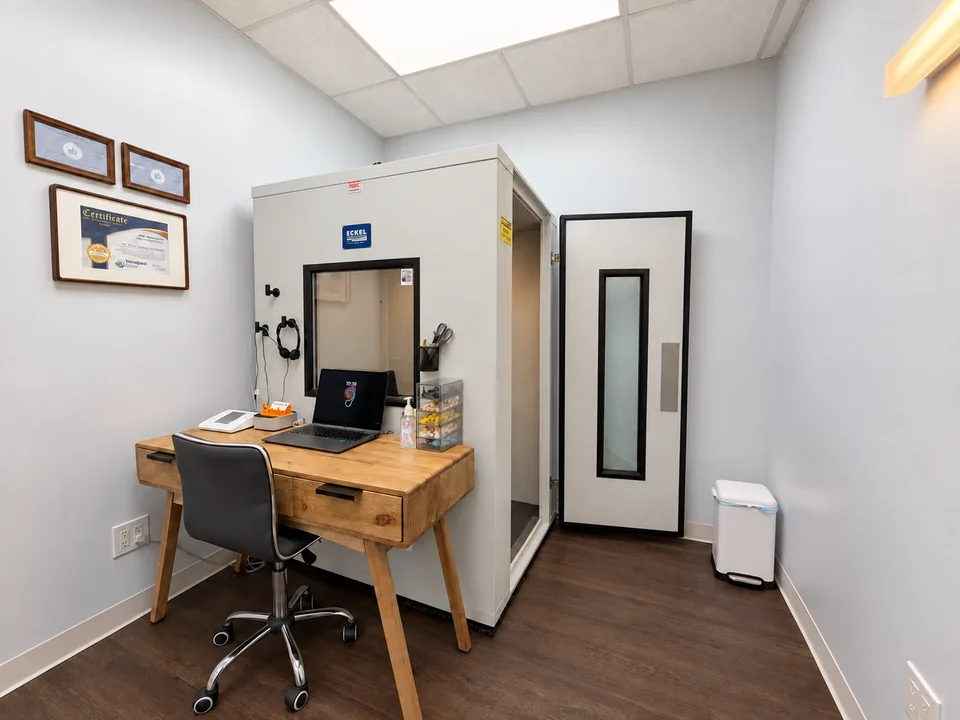
In practice, this is why an evaluation pairs standardized tests with functional measures and real-world report. A score tells us how a person performed on a specific task in a quiet booth. A teacher’s description of a noisy classroom, or an adult’s account of a crowded meeting, tells us whether that finding actually matters day to day. The most confident conclusions emerge when the numbers and the lived experience agree, and the most cautious ones are drawn when they pull in different directions.
Age, Development, and the Limits of Testing
Behavioral auditory processing tests demand a lot of a young child: sustained attention, consistent responses, comfort with headphones, and enough language to handle English-based materials. For that reason, testing children age 8 and younger calls for particular caution, because the auditory, language, and attention systems are still maturing, and an immature or inattentive response can masquerade as an auditory deficit.
This is why the field generally frames comprehensive evaluation as most appropriate from around age 7, with readiness, not the calendar alone, as the deciding factor. It is equally important to say the opposite clearly: this does not mean a younger child can never be assessed, only that younger children require careful clinical judgment and may not yet be candidates for a definitive behavioral diagnosis.
Cognition, memory, motivation, fatigue, and attention all shape performance on these tasks. A tired, anxious, or inattentive listener can score poorly for reasons that have nothing to do with central auditory function. Good clinicians build these factors into interpretation rather than pretending they do not exist. That humility is not a weakness of the field; it is what separates a responsible evaluation from a checkbox.

Where APD Meets Other Conditions
Few topics generate more confusion than the relationship between APD and attention, language, and learning. The honest summary is that these conditions overlap in their day-to-day signs and can coexist, but they are not the same thing.
APD and ADHD
Both can produce missed instructions, inconsistent responses, distractibility, and listening fatigue. The difference clinicians look for is conditional: attention-related difficulty tends to appear across visual and auditory tasks alike, while auditory processing difficulty is often most pronounced when information is spoken, rapid, degraded, or buried in noise. A person can have APD, ADHD, both, or neither. Audiologists do not diagnose ADHD; that is the domain of physicians and psychologists, which is why collaboration matters. The oversimplified claim that APD is “just misdiagnosed ADHD” does a disservice to both.
APD, Language, and Learning Disorders
Auditory processing, language, and reading develop in tightly connected systems, so difficulties often cluster. Some children carry a language disorder, a reading disorder such as dyslexia, and measurable auditory processing weaknesses at the same time. Research using systematic reviews has repeatedly found overlap between children identified with APD and children with language or learning difficulties, which is one reason a team assessment, including speech-language pathology and, where relevant, psychology, is often the responsible path. An auditory processing test does not diagnose dyslexia or a language disorder; it clarifies one contributing piece.
APD and Autism
Auditory processing differences are also reported in autistic children and adults, and unusual responses to sound are common in autism. This calls for careful, respectful, non-stigmatizing evaluation that recognizes a person’s whole profile rather than reducing sensory experience to a single deficit label. The aim is understanding and support, not sorting people into boxes.
Treatment, Management, and the Honest Limits of the Evidence
Management of auditory processing difficulty rests on three broad pillars, and the strongest of them is environmental. Improving the signal the listener receives, through better classroom acoustics, reduced background noise, and, when clinically appropriate, remote microphone systems that send a speaker’s voice directly to the listener, has the most immediate and best-supported impact. These changes help regardless of the precise diagnostic label, which is part of why they are recommended so widely.
The second pillar is compensatory strategy: gaining attention before speaking, breaking instructions into shorter steps, pairing spoken information with written or visual support, pre-teaching vocabulary, checking comprehension, and allowing extra processing time. The third is direct intervention, including auditory training targeted to a specific identified deficit and, frequently, speech-language support for the language and literacy skills that travel with auditory difficulty.
Here candor is essential. The evidence base for some auditory training programs is still developing, and results vary; a program that helps one profile may do little for another. That is precisely why a generic, one-size auditory training package is less responsible than a plan built from an individual’s test pattern, history, and goals. The most defensible approach pairs well-supported environmental change with targeted, individualized intervention, and then measures progress rather than assuming it.
From Findings to a Plan
A result is only as useful as what it changes. After testing, the audiologist translates the pattern into recommendations a family, school, or workplace can actually use, and explains the reasoning in plain language. That might mean specific listening-environment changes, a trial of a remote microphone system, targeted training for an identified weakness, a referral for language or attention evaluation, or simply a plan to monitor and reassess.
A good report should state what the testing does not show as clearly as what it does, so no one over-reads a single number or turns a narrow finding into a sweeping explanation.
Reassessment matters as much as the first visit. Auditory skills keep developing through childhood, and demands shift as a student moves from picture books to fast lectures, so a finding at age eight is a starting point, not a verdict. Responsible practice builds in follow-up, measures whether the plan is actually working, and adjusts when it is not. The point is never to defend a diagnosis; it is to keep improving a real person’s day-to-day listening, and to change course honestly when the evidence says so.
When Families Should Seek an Evaluation
If a child consistently struggles to understand speech in noise, misses spoken directions, needs far more repetition than peers, or performs better with visual support, and a basic hearing screening has not explained it, an evaluation is reasonable, especially once the child is around age 7 and developmentally ready.
Adults who find listening in noise exhausting, or who notice a persistent gap between hearing and understanding, are equally appropriate candidates. Persistent tinnitus or unusual sensitivity to sound can accompany listening difficulty as well; our writing on what tinnitus sounds like and our tinnitus care may be relevant when those symptoms are part of the picture.
What should families expect from a qualified audiologist? A complete hearing evaluation first. An individualized battery rather than a fixed checklist. Interpretation that weighs age, language, attention, and history, not a single failed score. Plain-language findings. Written, realistic recommendations. And a willingness to say when the answer lies outside audiology and to coordinate with the professionals who can help. If attention, language, or learning questions are prominent, our companion article on ADHD, hearing, and listening difficulties explores how those pieces fit together.
For families, the practical takeaway is reassuring. You do not need to arrive with a diagnosis in mind or a specific test already chosen. You need a clinician who will listen to the history, measure carefully, and tell you honestly what the results do and do not mean, then help you decide what, if anything, to do next. That is available, and it is the right starting point whether the eventual answer turns out to be auditory processing, something else entirely, or a combination of factors working together.
Auditory processing disorder is real, it is worth taking seriously, and it is not a catch-all for every listening complaint. Holding both of those truths at once is the mark of good care. The goal is never a label for its own sake; it is a clear, honest understanding of why listening is hard, and a practical plan to make it easier.

Dr. Eric G. Nelson, Au.D., CCC-A
Founder and Clinical Director, Pinnacle Audiology. A doctor of audiology and former Audiology Supervisor and Residency Coordinator at Weill Cornell Medicine. Pinnacle Audiology now offers CAPD testing for adults ages 18 and older in Midtown Manhattan; this service is not offered for patients under 18.
Reviewed July 2026. This article is educational and does not replace an individual evaluation. It does not diagnose ADHD, dyslexia, a language disorder, or any specific condition.
References
- American Speech-Language-Hearing Association. (2005). (Central) Auditory Processing Disorders [Technical Report and Position Statement]. ASHA.
- American Academy of Audiology. (2010). Clinical Practice Guidelines: Diagnosis, Treatment and Management of Children and Adults with Central Auditory Processing Disorder.
- British Society of Audiology. (2011, reviewed subsequently). Position Statement and Practice Guidance: Auditory Processing Disorder (APD).
- Chermak, G.D., & Musiek, F.E. (Eds.). Handbook of Central Auditory Processing Disorder (Vols. I–II). Plural Publishing.
- de Wit, E., et al. (2016). “Characteristics of Auditory Processing Disorders: A Systematic Review.” Journal of Speech, Language, and Hearing Research, 59(2), 384–413.
- Iliadou, V.V., et al. (2017). “A European Perspective on Auditory Processing Disorder: Current Knowledge and Future Research Focus.” Frontiers in Neurology, 8:622.
- Wilson, R.H., et al. “Speech-in-noise measures, including the QuickSIN.” Journal of the American Academy of Audiology.
- Musiek, F.E., et al. “Gaps-In-Noise (GIN) test: development and pediatric findings.” Ear and Hearing / Journal of the American Academy of Audiology.
Clinical Sources
Get expert
hearing care.
Comprehensive evaluation, honest guidance, and long-term support, from New York's leading independent audiology practice.