
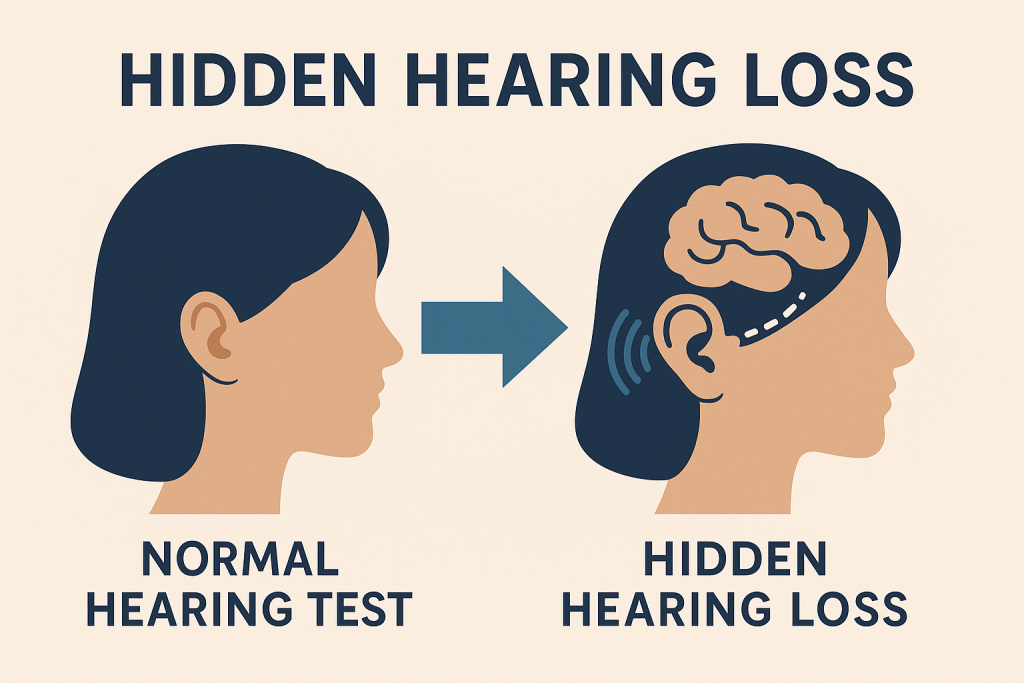
Most people think hearing loss is simple. You either hear well, or you don’t. You either pass a hearing test, or you fail it. The truth is more complicated, especially in a city like New York where listening environments are intense, layered, and demanding. Many people who come to Pinnacle Audiology tell me the same thing. They say, “I hear fine in quiet rooms, but in restaurants or meetings, everything turns into a blur.” They pass a standard hearing test with flying colors, yet they still struggle every day.
This disconnect is what audiologists call hidden hearing loss. It affects countless adults, especially those exposed to city noise, concerts, headphones, or years of occupational loud sound. Hidden hearing loss is easy to miss, but life changing once identified. It does not show up on a traditional hearing test, yet it affects clarity, focus, and the brain’s ability to separate speech from background noise.
This blog is a guide to understanding hidden hearing loss, why it happens, and how an experienced audiologist can help individuals find clarity even when their hearing test looks “normal.”
What Exactly Is Hidden Hearing Loss?
Hidden hearing loss happens when the ear and brain struggle with clarity, not volume. You may hear someone speaking, but understanding their words becomes difficult, especially when other sounds are present.
People often describe it as:
• “I hear you talking, but I can’t make out the words.”
• “Conversations melt together.”
• “Restaurants are impossible.”
• “Everyone sounds like they’re mumbling.”
• “I avoid group conversations because I can’t keep up.”
Hidden hearing loss occurs when the nerve fibers that carry sound from the ear to the brain start to weaken or disconnect. The outer hair cells may still function well enough to pass a hearing test, but deeper neural pathways are affected.
This means:
• The hearing test says you’re fine
• Your life experience says you’re not fine at all
This mismatch can be confusing and discouraging without the right evaluation.
Why Standard Hearing Tests Don’t Catch It
Traditional hearing tests measure how softly you can hear specific tones in a very quiet room. But real life doesn’t happen in quiet rooms. Real life happens in:
• Busy subway stations
• Meeting rooms full of competing voices
• Restaurants like Carmine’s or Bea
• Family gatherings
• Open office environments
• Cafés with espresso machines hissing in the background
Standard tests do not measure how well you hear in noise, how your brain processes speech, or how your auditory system handles fast, complex sound environments.
Most adults with hidden hearing loss pass a hearing test, but they still struggle because:
• Speech understanding happens at the brain level
• Background noise overwhelms neural pathways
• High-frequency details feel blurred
• The auditory nerve is not responding efficiently
• Their brain must “work harder” to fill in missing information
This is why so many New Yorkers say they feel mentally exhausted after social events or long workdays. Their brain is compensating for a hidden auditory deficit.
Who Is Most at Risk for Hidden Hearing Loss?
Hidden hearing loss can happen at any age, but certain groups are more vulnerable:
1. People exposed to city noise
NYC traffic, sirens, construction, and subway platforms all contribute to neural fatigue.
2. Musicians and frequent concertgoers
Even with earplugs, long-term exposure affects the auditory nerve.
3. People who use headphones often
AirPods, streaming music, podcasts, and work calls contribute to cumulative strain.
4. Adults in open office environments
Constant chatter and background sound challenge speech processing.
5. People who notice tinnitus
Ringing often accompanies early neural changes.
6. Adults who say “I hear fine, I just can’t understand people”
This is the classic profile.
If any of this feels familiar, hidden hearing loss may be the missing explanation.
The Brain’s Role: Why Listening Feels Difficult
Hidden hearing loss is not just an ear issue. It heavily involves the brain. When sound arrives too quickly, too loudly, or with too many competing layers, the brain must decode speech at lightning speed.
In hidden hearing loss, this process becomes inefficient. That leads to:
• Mental fatigue
• Difficulty following group conversations
• Trouble hearing soft or fast speech
• Difficulty hearing women’s and children’s voices
• Increased frustration in noisy places
• Feeling socially withdrawn
Your ears may hear the sound, but the brain cannot process it accurately.
Signs of Hidden Hearing Loss Families Often Notice First
Loved ones frequently notice changes before the individual does. Families tell me:
• “They ask ‘what’ more often.”
• “They seem disengaged at family dinners.”
• “They avoid noisy restaurants.”
• “They watch TV too loudly.”
• “They seem anxious in crowds.”
These subtle changes are often early signs that the auditory system is struggling even though the hearing test looks fine.
How Pinnacle Audiology Evaluates Hidden Hearing Loss
One of the biggest advantages of my background at Weill Cornell Medicine is experience with advanced diagnostic testing. For hidden hearing loss, a traditional hearing test is only the beginning.
A full evaluation includes:
1. Speech in Noise Testing
This is the most important tool. It measures how well you understand speech when background sound is present.
2. Extended High-Frequency Testing
Standard hearing tests only measure up to 8,000 Hz. Many early changes appear above that range.
3. Cognitive Listening Assessment
We measure how well the brain processes rapid speech cues.
4. Tinnitus Evaluation
Ringing can indicate early nerve pathway changes.
5. Real-World Listening Simulation
We recreate noisy environments to assess how the auditory system performs under stress.
6. Lifestyle Analysis
We look at:
• Work environment
• Restaurant habits
• Music exposure
• Headphone use
• Social routines
By combining these assessments, we uncover the full picture.
How Hidden Hearing Loss Is Treated
The good news is that treatment can be highly effective. Once we identify the neural patterns, we create a tailored plan.
1. Advanced Hearing Aid Technology
Even when hearing is technically “normal,” hearing aids with AI-driven processing can improve speech clarity dramatically. These devices:
• Focus on voices
• Reduce background noise
• Improve directionality
• Ease cognitive load
• Boost high-frequency details
• Help the brain separate speech from noise
They’re not amplifying volume. They’re enhancing clarity.
2. Remote Microphones
For meetings and restaurants, a small remote mic can send a speaker’s voice directly into your hearing aids. This is life changing for many patients.
3. Auditory Training
Computer-based programs help retrain the brain to decode speech more efficiently.
4. Tinnitus Tools
Sound therapy helps soften neural overload.
5. Environmental and Communication Strategies
We teach families small but impactful communication habits that reduce strain.
Patients often say:
• “I hear with less effort.”
• “Restaurants aren’t overwhelming anymore.”
• “I’m following conversations again.”
• “My brain doesn’t feel tired at night.”
These improvements typically happen quickly once the right tools are in place.
A Patient Story: When Normal Hearing Didn’t Match Real Life
One of my patients, a young attorney in Manhattan, came in because she constantly struggled during courtroom proceedings and group meetings. Her hearing test was completely normal. But her speech-in-noise scores were significantly below average.
We fitted her with discreet, rechargeable hearing aids with advanced speech processing and a dedicated “meeting” program. We also added a small remote microphone she could place near co-counsel during discussions.
Two weeks later, she told me, “I had no idea how much my brain was fighting to hear. Now I don’t feel drained by noon.”
Hidden hearing loss had been the missing piece.
The Emotional Side of Hidden Hearing Loss
Many people feel ashamed or confused when they struggle to understand speech even though their hearing test says they’re fine. They often blame themselves or assume they’re “not paying attention.”
The truth is simple. The auditory system is complex, and hidden hearing loss is incredibly common. Once patients understand what’s happening, they feel relief. Their confidence grows. Their communication improves. They re-engage socially. They feel less anxious.
Families also notice the change almost immediately.
Why NYC Listeners Need Expert Guidance
New York demands strong listening skills. The city’s acoustics are intense, and hidden hearing loss becomes obvious quickly in places like:
• West Village restaurants
• Broadway theaters
• Midtown lobbies
• Open office spaces
• Noisy apartments
• Subway cars
Most big-box hearing centers miss hidden hearing loss entirely. Pinnacle Audiology specializes in it.
With my background at Weill Cornell Medicine, advanced diagnostics, and custom technology programming, patients get the kind of nuanced care this condition requires.
A Final Word on Hidden Hearing Loss
Hidden hearing loss is real. It’s common. And it’s treatable. If you or someone you love feels like they hear but don’t always understand, the solution is not louder sound. It’s clearer sound. With the right evaluation and evidence-based treatment, listening becomes easier, conversations become natural, and daily life feels lighter.
You don’t have to struggle in silence. Your hearing deserves clarity.
Research from the National Institutes of Health (NIH) shows that hidden hearing loss is strongly linked to synaptic damage between the ear and the brain. https://www.nih.gov