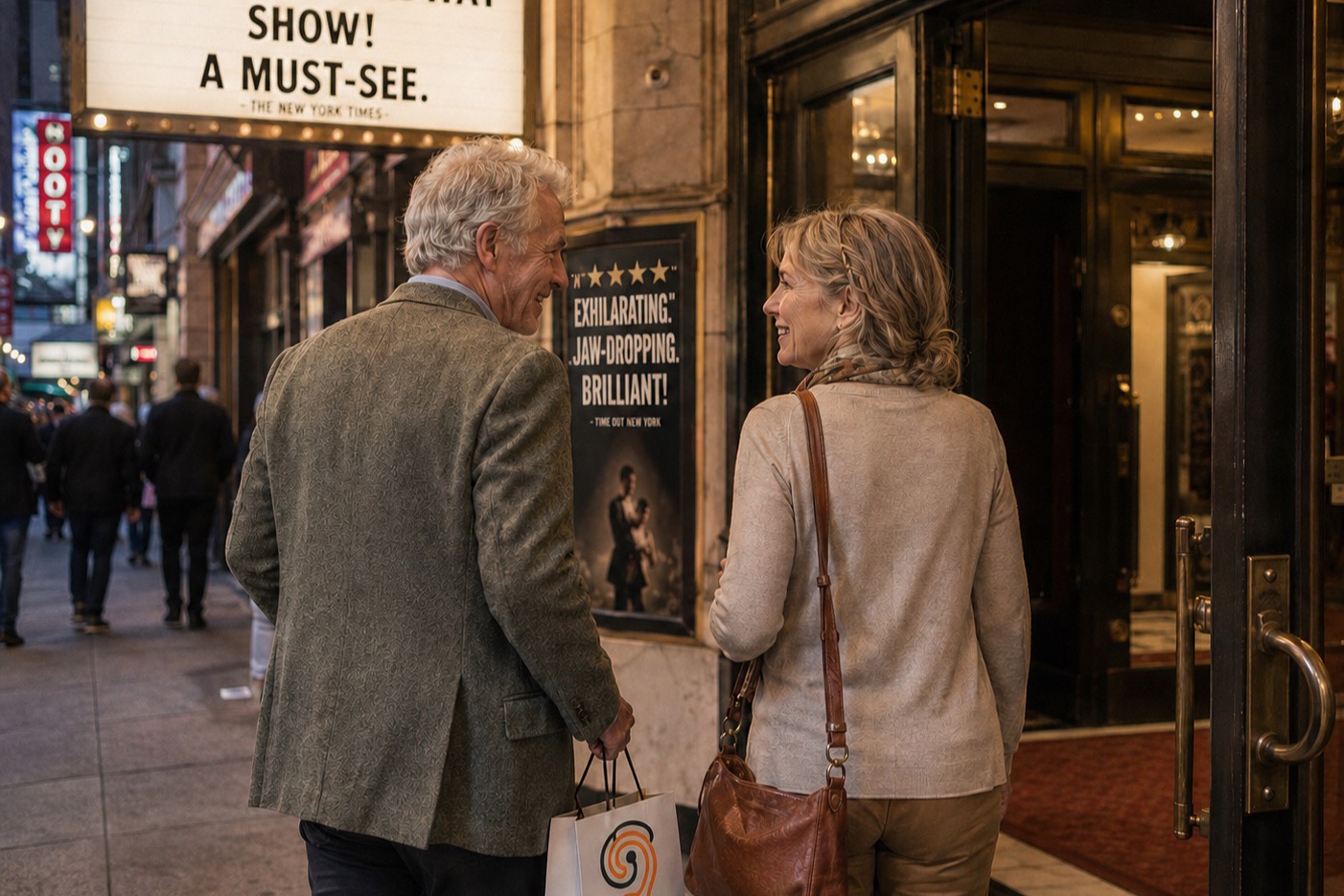
New York City is one of the great performing arts capitals of the world. From the ornate interiors of the historic Broadway houses to the intimate black-box theaters of Off-Broadway, live performance is a defining feature of life in this city. For people with hearing loss, attending a live show can shift from a source of joy to a source of frustration.
Why Live Theater Is Acoustically Demanding
The acoustic challenges of a large theater differ in important ways from other difficult listening environments. In a theater, the challenges include distance from the sound source, reverberation from hard walls and high ceilings, and the dynamic range between quiet dramatic dialogue and loud musical numbers. Many Broadway theaters were built in the early twentieth century, before the era of modern acoustic engineering. Frequent theatergoers who do not use hearing aids may prefer filtered custom earplugs when a production is uncomfortably loud because they can lower the level more evenly than standard foam.
Modern Broadway productions typically use extensive sound reinforcement, but the goal of theatrical sound design is usually dramatic immersion rather than speech clarity. People with even mild hearing loss, defined clinically as thresholds between 26 and 40 dB HL, may struggle to follow dialogue clearly.
Hearing Loop Technology in NYC Venues
The hearing loop, also called an induction loop or telecoil loop, is the most clinically effective assistive listening technology available in large venues. A hearing loop system consists of a wire installed around the perimeter of a seating area that transmits an electromagnetic signal directly to the telecoil (T-coil) inside a compatible hearing aid or cochlear implant processor.
New York City has made meaningful progress in venue looping. Lincoln Center's David Geffen Hall completed a comprehensive renovation that included a state-of-the-art hearing loop system. The Metropolitan Opera at Lincoln Center has had loop coverage in multiple seating zones for many years. Carnegie Hall, the Brooklyn Academy of Music, and a growing number of Broadway theaters have installed or are installing loop systems.
To use a hearing loop, your hearing aid must have a telecoil, and it must be activated by your audiologist. Many modern hearing aids have a T-coil that was never turned on during fitting, a common oversight that is easily corrected.
Infrared and FM Assistive Listening Systems
In venues without hearing loop systems, the most common assistive listening technology is either an infrared (IR) or FM-based system. These systems transmit the audio signal from the sound board wirelessly to a receiver device that the patron picks up at the box office. Both technologies provide a meaningful improvement over unaided listening, but they are less seamless than a hearing loop connected directly to a T-coil-equipped hearing aid.
Practical Strategies Before and During a Show
Seating selection has a meaningful impact on the listening experience. Mezzanine seating, particularly in the center section, often provides a favorable combination of direct sound and proximity to overhead delay speakers. Side seating can create an asymmetric listening experience, which is particularly problematic for people with asymmetric hearing loss or unilateral hearing aid use.
For hearing aid users, ensuring fresh batteries or a full charge before the performance is obvious but frequently overlooked. Some audiologists also recommend pre-programming a specific theater memory in hearing aids for patients who attend performances regularly.
When Professional Evaluation Changes Everything
A significant number of adults who report difficulty following dialogue in theaters have never had a formal audiological evaluation. The clinical reality is that difficulty hearing in theaters is often an early and telling symptom of sensorineural hearing loss. High-frequency hearing loss often does not cause a subjective sense of "things being too quiet", rather, it causes a sense that speech is muffled, unclear, or that people are mumbling.
Properly fitted hearing aids, with T-coil activation where applicable, have allowed many of our patients to return to regular theater attendance with meaningful satisfaction.
If Broadway, the Met, or your local theater has become harder to enjoy, do not give up your seat. A comprehensive hearing evaluation with a New York City audiologist can identify exactly what is getting in the way, activate the telecoil you may not know you have, and get you back to hearing every line. At Pinnacle Audiology, helping New Yorkers stay connected to the culture they love is a core part of what we do.

Use the theater's own system
Most Broadway and major New York theaters are legally required to offer assistive listening, and it is one of the most underused tools in the city. Ask the house manager or accessibility desk for an assistive listening receiver, which sends the show's sound directly to a headset or, in some venues, to a neck loop that streams into hearing aids equipped with a telecoil. Arriving a few minutes early to collect and test the device makes the difference between catching every lyric and straining all night.
Make your hearing aids work harder
If you wear hearing aids, ask your audiologist about a dedicated listening program for performances, one tuned to favor speech and music clarity over background management. A telecoil, or a compatible streaming accessory, lets the venue's audio flow straight into your aids with no echo. These features exist on most modern devices but often sit unused simply because no one set them up.
Plan the seat and the night
Where you sit matters less than people think once assistive listening is in play, but center seats and a spot away from chatty aisles still help. Treat a big night out as worth a little preparation. If shows have started to sound muffled, that is also a reason to check your hearing. Book an evaluation and we will make sure the city still sounds like the city.
References
- Lin, F.R., Pike, J.R., Albert, M.S., et al. (2023). "Hearing intervention versus health education control to reduce cognitive decline in older adults with hearing loss (ACHIEVE): a multicentre, randomised controlled trial." The Lancet. 402(10404):786–797.
- World Health Organization. (2021). World Report on Hearing. Geneva: WHO.
- Slade, K., Plack, C.J., & Nuttall, H.E. (2020). "The effects of age-related hearing loss on the brain and cognitive function." Trends in Neurosciences. 43(10):810–821.
- Livingston, G., Huntley, J., Liu, K.Y., et al. (2024). "Dementia prevention, intervention, and care: 2024 report of the Lancet standing Commission." The Lancet. 404(10452):572–628.
Clinical Sources
Get expert
hearing care.
Comprehensive evaluation, honest guidance, and long-term support, from New York's leading independent audiology practice.